


close
Choose Your Site
Global
Social Media


Views: 0 Author: Site Editor Publish Time: 2026-08-14 Origin: Site


Agricultural equipment operates in brutal, unforgiving environments. High mechanical stress, corrosive chemicals, and abrasive soils constantly attack structural components and ground-engaging tools. When a part fails in the field during a tight harvest window, it causes catastrophic downtime and severe yield loss. Original equipment manufacturers and procurement teams face a massive engineering challenge. They must source custom Agricultural Machinery Parts that meet strict durability and wear requirements. At the same time, they need to maintain cost-effective unit pricing and hit scalable production timelines. Mitigating field failures and controlling manufacturing costs requires a rigorous, data-driven evaluation. You must carefully analyze raw material properties, mechanical forming processes, and the technical capabilities of your manufacturing partners. Relying on sub-standard materials or mismatched production methods guarantees premature equipment failure. Building reliable farm machinery demands aligning the right metal alloys and advanced polymers with precise fabrication techniques.
Material selection dictates lifecycle: Balancing high-carbon steels for ground-engaging tools against advanced polymers (like Polyethylene) for weight reduction and corrosion resistance is critical for long-term field performance.
Process alignment drives ROI: Selecting between CNC machining, metal stamping, and forging depends entirely on production volume, required tolerances, and structural load requirements.
Prototyping mitigates risk: Validating form, fit, and function through rapid prototyping before investing in hard tooling prevents costly late-stage manufacturing defects.
Integrated manufacturing accelerates time-to-market: Consolidating material selection, tooling, production, and inspection with a single-source vendor reduces supply chain fragmentation and lead times.
Vendor evaluation requires QA scrutiny: Reliable manufacturing partners must demonstrate integrated quality control, from raw material traceability to robotic welding consistency and advanced surface finishing.
Table of Contents
Farm equipment endures continuous dynamic loads and extreme physical punishment. Rocks, dense clay, and uneven terrain deliver high-impact forces directly to the chassis, hitches, and ground-engaging tools. Engineers must design components to survive severe abrasion daily. A plow blade or cultivator tine loses material with every pass through silica-rich soil. You cannot rely on standard mild steel for these applications. Furthermore, moisture, liquid fertilizers, harsh pesticides, and intense UV radiation create a highly corrosive environment. Nitrogen-based fertilizers eat through bare metal rapidly. Parts will rust, degrade, and snap without proper material selection and robust surface protection. We see this constantly in the field when OEMs cut corners on material grades. The resulting downtime costs farmers thousands of dollars per hour during harvest.
Adhering to strict industry standards is non-negotiable in heavy equipment manufacturing. ISO 4254 and ASABE S318 guidelines dictate safety, interoperability, and performance baselines. Meeting these standards ensures equipment functions safely alongside other implements. This applies heavily to power take-off (PTO) shafts, hydraulic couplings, and drawbar hitches. Compliance directly impacts liability. Failing to meet ASABE benchmarks increases warranty claims, triggers safety recalls, and permanently damages brand reputation. Procurement teams must verify that their manufacturing partners understand these specific agricultural standards. You need a vendor who documents material traceability and dimensional inspections to prove compliance during an audit.
Success criteria shift dramatically based on the manufacturer's size and market focus. Niche specialty implement builders need flexible, low-volume production runs. They prioritize rapid design iteration, laser cutting, and lower upfront tooling investments. Press braking and manual welding often make sense for runs of fifty to one hundred units. Conversely, mass-market broad-acre tractor brands demand high-volume scalability. They require processes like progressive die stamping and automated forging that deliver millions of identical parts with zero deviation. You must align your chosen manufacturing process with the expected lifecycle volume of the specific components to maintain profitability. Mismatching the process to the volume either inflates the piece price or wastes capital on unnecessary hard tooling.
Ground-engaging tools require maximum hardness and yield strength. High-carbon steels like 1045 and boron-alloyed steels like 10B38 provide the extreme wear resistance necessary for slicing through abrasive soil. These steels undergo specific quenching and tempering heat treatments to withstand constant friction without losing their edge. Heavy structural components demand entirely different mechanical properties. Ductile iron castings, specifically ASTM A536 Grade 65-45-12, excel in applications like heavy-duty gearboxes, wheel hubs, and axle housings. The graphite nodules within ductile iron allow it to absorb heavy vibrations. It provides immense structural rigidity under massive loads without fracturing. We specify ductile iron when a component needs the castability of gray iron but the mechanical strength of steel.
Weight reduction directly improves fuel efficiency and reduces soil compaction in the field. Aluminum alloys offer excellent structural integrity while significantly cutting overall equipment weight. Engineers frequently specify high-strength aluminum, like 6061-T6, for wide sprayer booms, precision planting components, and lightweight access panels. You must carefully analyze the mechanical trade-offs. Non-ferrous metals carry higher raw material costs upfront compared to standard carbon steel. However, the resulting fuel efficiency gains and reduced soil impact often justify the initial expense over the tractor's operational lifespan. Aluminum also provides natural corrosion resistance, eliminating the need for heavy powder coating on certain elevated components.
Industrial plastics are fundamentally transforming modern farm equipment design. Ultra-high-molecular-weight (UHMW) polyethylene and glass-reinforced nylons dominate applications like seed tubes, fertilizer hoppers, and low-friction wear pads. These advanced polymers completely eliminate rust issues caused by acidic soil additives. They also shed mud and debris much better than bare metal, preventing blockages in planting equipment. Integrating composites reduces overall equipment weight and drastically extends the lifespan of components constantly exposed to corrosive chemical fertilizers. We replace heavy steel chain guides with UHMW plastics to reduce chain wear and eliminate lubrication requirements in dusty environments.
Selecting the right material requires a strict, objective decision framework. Engineering teams must weigh raw material costs against machinability, tooling lifespan, and expected field longevity. A cheaper steel might save money upfront but cost thousands in premature replacement parts and warranty labor. You must evaluate the operational environment before finalizing the bill of materials.
Identify the primary failure mode for the part, whether it is abrasion, impact, corrosion, or fatigue.
Calculate the maximum dynamic load the component will experience during field operation.
Determine the target weight limit to meet soil compaction and fuel efficiency goals.
Assess the chemical exposure risk from fertilizers, pesticides, and environmental moisture.
Compare the raw material cost against the projected tooling investment required to form it.
Material Performance and Application Matrix
Material Type | Primary Advantage | Common Agricultural Application | Relative Cost |
|---|---|---|---|
High-Carbon / Boron Steel | Extreme wear and abrasion resistance | Plow blades, cultivator tines, disc harrows | Moderate |
Ductile Iron | Vibration dampening, high structural rigidity | Gearbox housings, axle components, heavy hubs | Low to Moderate |
Aluminum Alloys | High strength-to-weight ratio, corrosion resistance | Sprayer booms, precision metering units | High |
UHMW Polyethylene | Zero corrosion, low friction, impact resistant | Seed hoppers, wear pads, chemical tanks | Moderate to High |
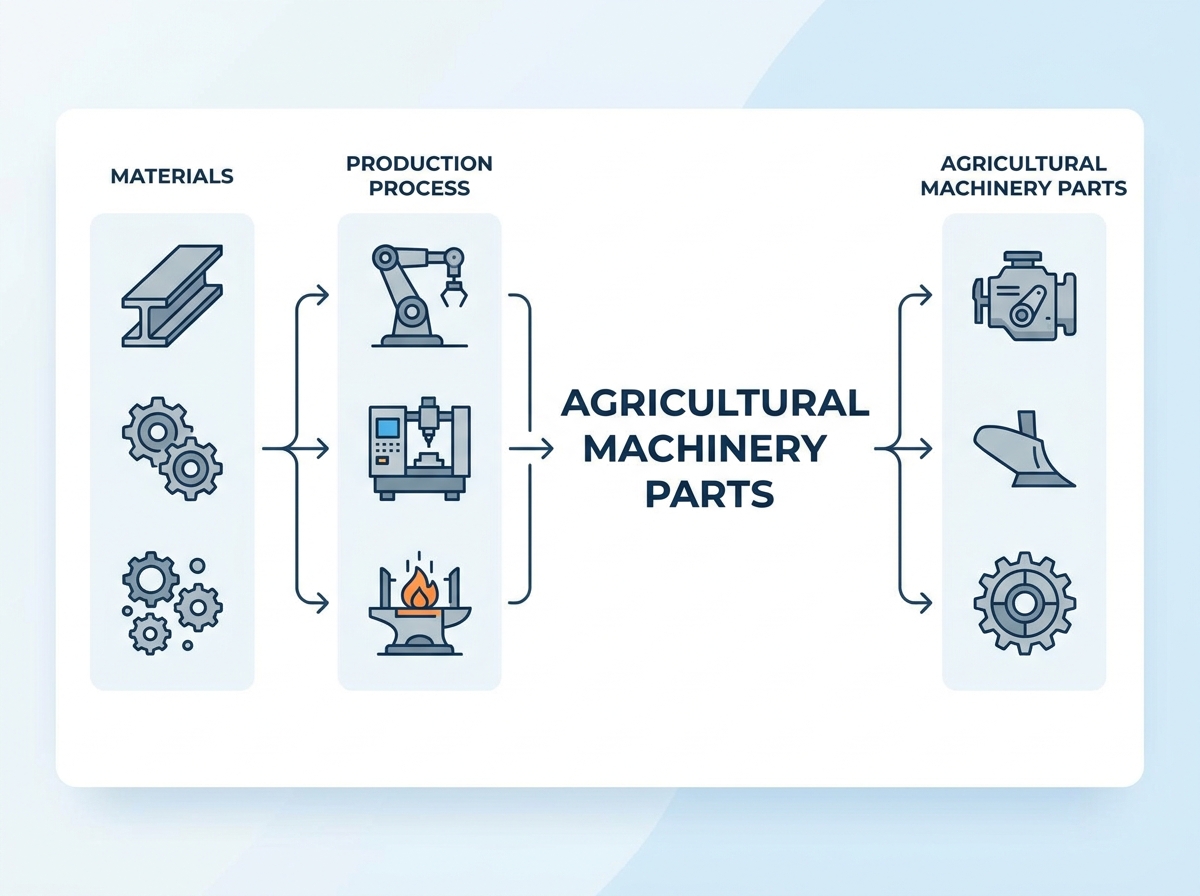
Mechanical forming relies on extreme physical pressure. Applying massive force to solid metals aligns the internal grain structures, eliminating microscopic voids. This physics-driven process produces the highest-strength parts available in heavy manufacturing. Hitches, PTO driveshafts, and critical load-bearing joints rely on hot closed-die forging to prevent catastrophic failure under heavy towing loads. Rolling and extrusion create uniform, continuous profiles. Manufacturers use these continuous steel shapes to build rigid structural frames, heavy-duty chassis rails, and protective roll-over structures. Hot rolling structural steel provides the necessary yield strength for tractor frames that must resist twisting forces across uneven terrain.
CNC machining excels at producing complex geometries from solid billets or castings. Hydraulic manifolds, transmission gears, and engine components require tight tolerances that only multi-axis precision machining can achieve. We regularly machine hydraulic ports to tolerances of +/- 0.0005 inches to prevent high-pressure fluid leaks. For processing sheet metal and plate steel, laser cutting provides a highly efficient, tool-less solution. Fiber lasers cut custom brackets, gussets, and chassis components rapidly with minimal kerf width. Laser cutting easily slices through one-inch thick mild steel plate. It is especially valuable for low-to-medium volume production runs because it eliminates the need for expensive custom stamping dies.
Metal stamping delivers massive return on investment for high-volume production lines. Standardized Agricultural Machinery Parts benefit heavily from this rapid forming process. Stamping requires a significant upfront investment in hardened steel progressive dies. However, it drastically reduces the long-term piece-price by stamping out parts in seconds. Protective shields, motor covers, and structural body panels are ideal candidates for stamping and deep drawing once production volumes scale up to mass-market levels. A well-maintained progressive die can produce hundreds of thousands of identical brackets, completely offsetting the initial tooling expenditure.
Heavy agricultural frames demand flawless, deep-penetrating joints. Robotic welding is mandatory for ensuring consistent weld penetration and structural integrity across large assemblies. Automated robotic arms deliver exact repeatability, eliminating the inconsistencies of manual welding across thousands of tractor frames. They control the heat-affected zone perfectly, preventing metal distortion. Strategic manufacturing vendors go beyond basic welding. They provide complete sub-assembly services. Delivering ready-to-install, pre-welded modules directly to the OEM assembly line reduces factory bottlenecking and slashes internal labor costs. You receive a complete chassis module rather than a pallet of loose brackets and tubes.
Bare metal will not survive a single planting season. Powder coating and hot-dip galvanizing act as primary defenses against chemical and environmental corrosion. Galvanizing completely submerges the part in molten zinc according to ASTM A123 standards. This creates a metallurgical bond and a sacrificial anode effect that offers supreme rust prevention, even if the surface gets scratched by rocks. Powder coating provides excellent adhesion properties and high impact resistance. A thick, electrostatically applied powder-coated finish deflects rock strikes and resists harsh pesticide chemicals effectively. We bake the powder finish to cure it into a hard, impermeable shell that passes 1000-hour salt spray tests and keeps the underlying steel intact through years of field abuse.
Wear parts need exceptionally hard surfaces to resist constant abrasion from soil and rocks. However, they also need a tough, ductile core to absorb sudden impacts without shattering. Localized heat treatment solves this specific engineering challenge. Processes like induction hardening and carburizing increase the surface hardness of specific wear zones on a gear or blade. We use induction coils to rapidly heat the cutting edge of a blade to achieve 50-55 HRC, then quench it immediately. This targeted thermal approach prevents brittle fractures while maximizing the lifespan of ground-engaging edges and high-torque transmission components.

Partnering with manufacturers who offer robust DFM engineering support controls costs early in the product lifecycle. Expert manufacturing engineers optimize part designs for specific production methods. They adjust draft angles, bend radii, and material utilization to eliminate waste. They might suggest redesigning a heavy machined part into a multi-piece stamped and welded assembly to save material costs. The prototyping phase allows you to assess form, fit, and function practically in the real world. Validating the physical prototype through field testing prevents catastrophic errors before you commit capital to expensive mass production tooling. We always run a soft-tooled prototype batch to verify assembly tolerances before cutting hardened steel dies.
Evaluate potential manufacturers based on their level of vertical integration. The most reliable partners connect material selection, in-house die tooling, stamping, robotic welding, and inspection under one roof. A single-source, integrated process minimizes your reliance on third-party subcontractors. Keeping operations in-house reduces supply chain fragmentation and lowers logistics costs. It also mitigates tooling delays, protects intellectual property, and ensures strict accountability across the entire production cycle. When a single vendor controls the raw material cutting, the forming, and the final powder coating, they cannot blame a subcontractor for missed tolerances.
Reliable production requires strict, documented QA protocols. First Article Inspection (FAI) verifies that the initial production parts meet all blueprint specifications perfectly before the full run begins. Non-Destructive Testing (NDT), such as ultrasonic or magnetic particle inspection, ensures weld integrity without destroying the component. We use ultrasonic testing to find subsurface voids in critical structural welds. Coordinate measuring machine (CMM) verification guarantees that machined tolerances match the 3D CAD models exactly down to the micron level. Demand these rigorous QA frameworks from any prospective manufacturing partner to ensure consistent field performance.
Initiate a Design for Manufacturability (DFM) review with your engineering team to identify heavy machined parts that can transition to cost-effective metal stamping.
Request a material consultation from your manufacturing partner to explore weight-saving UHMW polymer alternatives for non-load-bearing components.
Commission a short-run prototype build to physically validate a prospective vendor's dimensional accuracy, weld penetration, and lead time reliability.
Audit potential suppliers for vertical integration, ensuring they possess in-house tooling, laser cutting, and robotic welding capabilities to eliminate subcontractor delays.
Founded in 1993, Hangzhou Emax Industrial Co., Ltd has developed extensive manufacturing experience across agricultural machinery parts, stamping components, sheet metal parts, and other industrial hardware, supported by an approximately 11,000-square-meter facility. By combining manufacturing capabilities with a strong focus on product quality and customer requirements, Emax provides OEM customers with a reliable partner for component sourcing and customized manufacturing projects.
A: Manufacturers primarily use high-carbon and boron steels for ground-engaging tools due to their extreme wear resistance. Ductile iron is common for heavy structural housings and gearboxes. Aluminum alloys reduce weight in sprayer booms, while advanced polymers like Polyethylene (PE) are used for corrosion-proof seed hoppers and low-friction wear pads.
A: Metal stamping is ideal for high-volume production. It requires high upfront tooling costs but delivers a very low piece-price for standardized parts like shields and panels. CNC machining is better for low-volume, high-precision components like hydraulic manifolds, requiring no custom dies but having a higher per-part cost.
A: Robotic welding ensures exact repeatability and consistent weld penetration across heavy structural frames. It eliminates human error and fatigue, guaranteeing that critical load-bearing joints meet strict strength requirements. Automated welding also significantly increases production speed and controls the heat-affected zone for high-volume tractor chassis assemblies.
A: Polyethylene and other industrial plastics provide total corrosion resistance against harsh fertilizers and pesticides. They offer significant weight reduction compared to steel and feature low-friction properties. This makes them perfect for seed tubes, chemical tanks, and hoppers where smooth material flow is mandatory.
A: Engineers ensure durability through Design for Manufacturability (DFM) analysis, computer stress simulations, and rapid prototyping. Manufacturers conduct First Article Inspections (FAI) to verify dimensions and perform extensive field testing on prototypes to validate real-world performance before investing in hard production tooling.
A: A fully integrated manufacturer handles tooling, stamping, machining, welding, and inspection under one roof. This single-source approach eliminates reliance on multiple subcontractors, reduces supply chain fragmentation, shortens lead times, and ensures strict, unified quality control throughout the entire production process.