


close
Choose Your Site
Global
Social Media


Views: 0 Author: Site Editor Publish Time: 2026-07-28 Origin: Site


Material selection dictates whether an industrial component survives its intended lifespan or fails prematurely in the field. Engineers constantly balance mechanical performance requirements against environmental exposure limits. You must weigh high tensile strength against the realities of moisture, chemical contact, and thermal cycling. Evaluating Carbon Steel vs Stainless Steel requires an objective look at metallurgical properties and specific industrial use cases. This guide provides a direct comparison of these two fundamental materials. We will examine how their chemical compositions dictate mechanical behavior, machinability, and environmental tolerance. You will see exactly how structural capabilities, fabrication constraints, and risk mitigation strategies guide your next design decision on the shop floor.
Corrosion Resistance vs. Cost: Stainless steel provides superior, inherent corrosion resistance due to its chromium content, but at a significantly higher raw material cost compared to carbon steel.
Strength and Hardness: High-carbon steel generally outperforms standard austenitic stainless steels in yield strength and surface hardness, making it preferable for high-wear, high-impact applications.
Machinability Trade-offs: Carbon steel is typically easier and faster to machine, whereas stainless steel is prone to work hardening, requiring specialized tooling and slower feed rates.
Lifecycle Value: The true cost of carbon steel must include secondary surface treatments (galvanizing, coating) and maintenance, which can offset its initial price advantage over stainless steel in corrosive environments.
Table of Contents
Carbon steel is defined by its primary alloying element. Carbon content typically ranges from 0.05% to 2.0% by weight. This specific concentration fundamentally alters the mechanical properties of the iron base. Carbon acts interstitially within the iron lattice. Because carbon has an atomic number of 6, its small atoms fit between the larger iron atoms. This arrangement forms cementite rather than free graphite. Cementite dictates the overall hardness and tensile strength of the material. When you increase the carbon content, you increase the volume of cementite, which restricts the movement of dislocations within the crystal lattice. This restriction makes the steel harder and stronger, but simultaneously more brittle.
Varying the carbon content directly controls ductility, weldability, and toughness. Low-carbon or mild steel contains up to 0.30% carbon. It is highly ductile and easy to weld, making it standard for structural shapes like I-beams and channel iron. Medium-carbon steel ranges from 0.31% to 0.60% carbon. It balances strength and ductility, suitable for automotive components like axles and forged gears. High-carbon steel contains above 0.60% carbon. It achieves extreme hardness through heat treatment but sacrifices weldability and ductility. Engineers specify high-carbon alloys for cutting tools, heavy-duty springs, and high-wear industrial parts where deformation is unacceptable.
In the field, these differences are obvious. If you take a piece of 1018 low-carbon steel, you can bend it cold in a press brake without fracturing. If you attempt the same cold bend on a piece of 1095 high-carbon steel, it will snap violently. The interstitial carbon locks the grain structure, preventing the plastic deformation required for cold forming. This basic metallurgical reality dictates the entire manufacturing process, from initial cutting to final assembly.
Stainless steel is defined by a minimum requirement of 10.5% chromium by mass. This chromium addition transforms the alloy's environmental reaction. Chromium reacts with oxygen to form a microscopic, passive chromium oxide layer on the material surface. This layer prevents further oxidation and rust. It is also self-healing. If the surface is scratched by a tool or abrasive material, the exposed chromium immediately reacts with ambient oxygen to rebuild the protective barrier. This passive layer is only a few nanometers thick, yet it completely alters the material's lifespan in wet environments.
Industrial stainless steels are categorized by their crystalline structures, which are determined by their specific alloy mixtures. Austenitic grades, like 304 and 316, contain significant amounts of nickel. They are non-magnetic, highly formable, and offer excellent corrosion resistance. Martensitic grades, such as 410, contain higher carbon and lower chromium. They can be hardened via heat treatment for cutlery, pump shafts, and surgical instruments. Ferritic grades, like 430, are magnetic and offer moderate corrosion resistance without the addition of nickel, making them common in automotive exhaust systems. Duplex stainless steels combine austenitic and ferritic structures. They deliver exceptional strength and localized corrosion resistance for severe chemical environments, such as offshore oil rigs and desalination plants.
The addition of other elements further refines these categories. Molybdenum is added to grade 316 to resist chloride pitting, making it the standard for marine hardware. Titanium is added to grade 321 to stabilize the carbon and prevent carbide precipitation during welding. Understanding these micro-alloying additions is necessary when specifying materials for aggressive industrial environments.
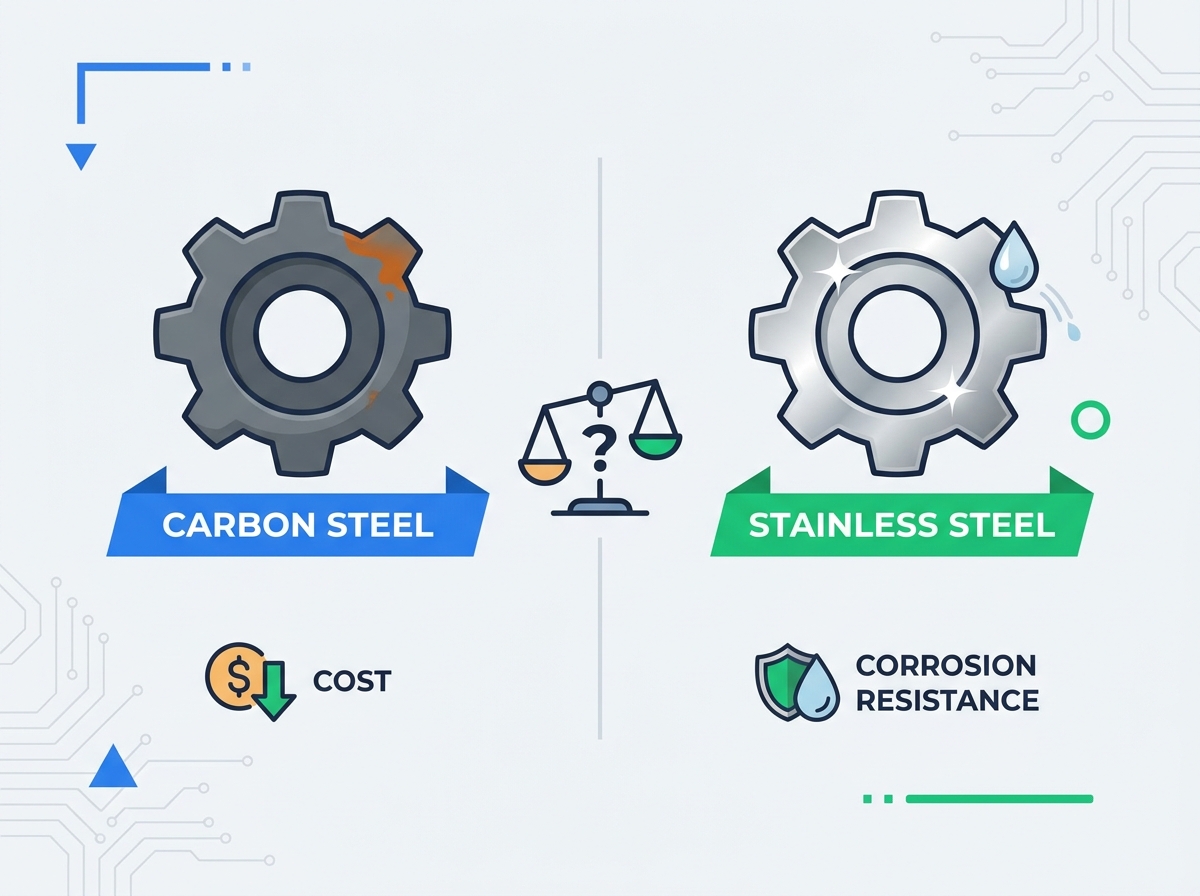
Stainless steel excels in aggressive environments. Austenitic grades dominate marine, acidic, and high-moisture applications. Grade 316 includes a specific molybdenum addition. This element drastically improves resistance to chloride-induced pitting and crevice corrosion. Chemical processing plants rely on these alloys to maintain purity and prevent catastrophic leaks. The passive oxide layer remains stable across a wide pH range. When working in a food processing facility, you will see 304 and 316 stainless steel used exclusively for washdown areas, mixing vats, and conveyor frames. The material withstands daily exposure to harsh caustic cleaning chemicals without degrading.
Carbon steel remains highly vulnerable to oxidation. When exposed to moisture and oxygen, iron converts to iron oxide, commonly known as rust. This reaction causes material flaking and progressive structural degradation. Carbon steel requires strict environmental isolation. Engineers must specify secondary surface treatments like hot-dip galvanizing, electroplating, or heavy industrial painting. Without these barriers, bare carbon steel will rapidly fail in outdoor or humid applications. In heavy construction, you often see carbon steel beams coated in thick layers of zinc-rich primer and epoxy topcoats. If that coating is scratched down to the bare metal, rust will immediately begin to form and undercut the surrounding paint.
The environmental tolerance of a material dictates its maintenance schedule. A stainless steel manifold in a wastewater treatment plant might require zero exterior maintenance for twenty years. A carbon steel manifold in the same environment would require regular abrasive blasting and recoating to prevent structural failure. You must evaluate the operating environment accurately before selecting the base material.
Mechanical load-bearing capabilities vary significantly between these material families. Standard low-carbon steels like AISI 1020 offer moderate yield strength suitable for general fabrication. Upgrading to AISI 1045 provides higher strength for shafts and gears. Austenitic stainless steels like 304 and 316 exhibit lower initial yield strengths than medium-carbon steels but offer massive ductility. They can absorb significant impact energy before fracturing. This makes austenitic stainless steel excellent for applications requiring crash resistance or seismic tolerance.
Heat treatment responses dictate specific industrial applications. High-carbon steel achieves extreme surface hardness. Quenching the heated alloy traps carbon within a distorted martensitic structure. This transformation creates unparalleled wear resistance for cutting blades, heavy-duty bearings, and earth-moving equipment wear plates. Standard austenitic stainless steels cannot be hardened through thermal treatment. They rely on cold working to increase strength, which limits their use in high-abrasion environments. If you need a shaft to resist heavy abrasive wear from sand or grit, a case-hardened carbon steel alloy like 8620 will vastly outperform a 304 stainless steel shaft.
Mechanical Property Comparison (Typical Values) | ||||
Material Grade | Yield Strength (MPa) | Tensile Strength (MPa) | Hardness (Brinell) | Elongation (%) |
|---|---|---|---|---|
1018 Carbon Steel (Cold Drawn) | 370 | 440 | 126 | 15 |
1045 Carbon Steel (Hot Rolled) | 310 | 565 | 163 | 16 |
4140 Alloy Steel (Annealed) | 415 | 655 | 197 | 25 |
304 Stainless Steel (Annealed) | 215 | 505 | 123 | 70 |
316 Stainless Steel (Annealed) | 205 | 515 | 149 | 60 |
17-4 PH Stainless (Condition H900) | 1170 | 1310 | 388 | 10 |
Manufacturing impacts often drive material selection. Carbon steel generally provides excellent machinability. It produces predictable chip formation during milling and turning. The lower shear strength of mild steel reduces cutting forces. This allows for higher spindle speeds and faster material removal rates. Predictable machining extends the life of carbide inserts and reduces overall cycle times. When turning a 1018 carbon steel shaft on a lathe, the chips break cleanly, falling into the chip pan without wrapping around the chuck. This predictability allows for unattended "lights-out" machining operations.
Stainless steel presents distinct machining challenges. The material tends to gall and adhere to cutting tools. Austenitic grades are highly prone to work hardening. If a tool rubs against the surface without cutting, the localized area becomes extremely hard. This ruins subsequent cutting passes and shatters tooling. Machinists must use rigid setups, specialized tool geometries, and aggressive feed rates. Copious high-pressure coolant is mandatory. These factors increase consumable tooling wear and extend CNC machining cycle times. When drilling a deep hole in 316 stainless steel, you must use a parabolic flute drill and high-pressure through-tool coolant to evacuate the stringy chips before they pack the hole and snap the drill bit.
Formability also differs greatly. Low-carbon steel draws and stamps easily, making it the standard for automotive body panels. Austenitic stainless steel requires significantly more tonnage to form due to its high work-hardening rate. Press brakes and stamping dies must be built heavier and more rigid to handle stainless steel. The material also exhibits more springback after bending, requiring operators to over-bend the material to achieve the final desired angle.
Low-carbon steel is the industry standard for ease of welding. It tolerates a wide range of heat inputs and shielding gases. The low carbon equivalent prevents brittle microstructures from forming in the weld zone. Fabricators can rapidly join heavy structural sections with minimal preheating or post-weld heat treatment. This makes it ideal for large-scale construction and heavy machinery frames. You can weld mild steel using MIG, TIG, or Stick processes with highly forgiving parameters. Even if the joint is slightly contaminated with mill scale or light oil, a skilled welder using an E7018 electrode can produce a sound, x-ray quality weld.
Stainless steel requires strict thermal controls during welding. Excessive heat input causes sensitization. Chromium combines with carbon to form chromium carbides along the grain boundaries. This depletes the surrounding area of chromium, destroying the localized corrosion resistance. The heat-affected zone becomes susceptible to intergranular corrosion. Welders must use precise heat inputs, specialized filler metals, and thorough back-purging with inert gas to protect the weld root. When welding stainless steel pipe for a sanitary food line, you must purge the inside of the pipe with argon gas. If you fail to purge the pipe, the back of the weld will react with oxygen, creating a porous, oxidized surface known as "sugaring" that harbors bacteria and ruins the sanitary rating.
Welding Parameter Comparison (TIG / GTAW) | ||
Parameter | Carbon Steel (1018) | Stainless Steel (304L) |
|---|---|---|
Shielding Gas | 100% Argon or Argon/CO2 mix | 100% Argon |
Back Purging Required | No | Yes (Mandatory for sanitary/pipe) |
Filler Metal | ER70S-2 or ER70S-6 | ER308L |
Heat Input Tolerance | High | Low (Must prevent sensitization) |
Pre-weld Cleaning | Grind to bare metal | Dedicated stainless wire brush, acetone wipe |
Thermal properties dictate performance in heat exchangers and high-temperature environments. Carbon steel possesses superior thermal conductivity. It transfers heat efficiently, making it standard for industrial boiler tubes and radiators. However, bare carbon steel suffers from rapid scaling and oxidation at elevated temperatures. It loses structural integrity quickly when exposed to continuous extreme heat. If you place a piece of bare carbon steel in a 1000°F furnace, it will rapidly form a thick layer of black iron oxide scale that flakes off, progressively thinning the material until it fails.
Stainless steel resists scaling and oxidation at high temperatures. The chromium oxide layer remains stable, protecting the underlying metal from thermal degradation. Grades like 309 and 310 are specifically designed for furnace components and exhaust systems. While stainless steel has lower thermal conductivity, its ability to maintain mechanical strength under extreme thermal cycling makes it indispensable for high-temperature industrial processing. In a gas turbine exhaust system, 310 stainless steel is used because it maintains its shape and resists oxidation at temperatures exceeding 1800°F, an environment where carbon steel would turn to dust.
Carbon steel dominates applications requiring massive structural rigidity and impact resistance. Engineers specify this material when environmental exposure is controlled or easily mitigated through secondary coatings.
Heavy structural machinery components, excavator booms, and crane frames.
Automotive chassis, suspension linkages, and drive shafts.
Structural building beams, columns, and infrastructure supports.
High-load gears, axles, and power transmission components.
Industrial cutting tools, stamping dies, and heavy-duty wear plates.
Success criteria include high impact resistance and structural rigidity. The operating environment must be dry, controlled, or sealed. Secondary coatings must be viable and maintainable throughout the product lifecycle. If you are designing a heavy-duty conveyor frame for an indoor warehouse, carbon steel coated with a durable powder coat is the correct engineering choice. It provides the necessary strength and rigidity without the unnecessary material premium of stainless alloys.
Stainless steel is mandatory for applications demanding strict hygiene, continuous fluid exposure, and zero contamination risk. It is specified when the cost of failure or contamination is unacceptable.
Food and beverage processing lines, sanitary piping, and mixing vats.
Medical instruments, surgical implants, and sterilization trays.
Marine hardware, offshore rigging components, and boat propellers.
Chemical storage vessels, pharmaceutical reactors, and distillation columns.
High-pressure valves, fluid control manifolds, and cryogenic equipment.
Success criteria focus on strict regulatory compliance, such as FDA or USDA standards. The application requires continuous exposure to aggressive fluids. Cleanability and aesthetic requirements must be met without relying on secondary coatings that could flake or degrade. In a dairy processing plant, every pipe, valve, and tank must be made of 304 or 316 stainless steel. The equipment must withstand daily cleaning with hot caustic soda and nitric acid. Carbon steel, even if coated, would eventually chip, rust, and contaminate the milk supply.

Directly joining carbon steel and stainless steel creates an electrochemical risk. When an electrolyte like water or salt spray bridges the two metals, galvanic corrosion occurs. The less noble metal, carbon steel, acts as an anode and corrodes rapidly. The stainless steel acts as the cathode and remains protected. This accelerated degradation causes catastrophic fastener failure or structural weakening. I have seen carbon steel bolts completely dissolve within months when used to secure stainless steel brackets on a marine dock.
Mitigation requires physical isolation. Engineers must break the electrical connection between the dissimilar metals. Proper drainage design also prevents electrolyte pooling at mixed-metal junctions.
Use dielectric washers and non-conductive isolation gaskets at all bolted joints.
Apply specialized sacrificial coatings, like zinc plating, to the carbon steel components.
Standardize fastener materials to match the most noble metal in the assembly.
Apply heavy dielectric grease or sealant to the joint to exclude moisture.
Work hardening destroys tooling and halts production. When machining austenitic stainless steel, improper cutting parameters cause the material surface to harden instantly. This occurs when tools rub rather than shear the metal. Subsequent passes hit this hardened layer, causing catastrophic tool failure and dimensional inaccuracies. If a drill bit dulls slightly and rubs the bottom of a hole in 304 stainless, the bottom of that hole becomes harder than the drill bit itself. You will hear a high-pitched squeal, and the drill will simply melt.
Shop-floor realities demand rigid machine setups to eliminate vibration. Machinists must use sharp, positive-rake carbide tooling. High feed rates ensure the cutting edge gets beneath the work-hardened zone from the previous pass. Optimized, pressurized coolant delivery is critical. It lubricates the cut and removes heat before it alters the material's microstructure. Never allow a tool to dwell or idle against a stainless steel workpiece. The tool must always be advancing and cutting a clean chip.
High-strength carbon steel requires surface protection, but the coating process introduces severe risks. Acid pickling and electroplating expose the steel to atomic hydrogen. These tiny atoms diffuse into the steel lattice. Under mechanical stress, the trapped hydrogen causes sudden, brittle fracture. This phenomenon, known as hydrogen embrittlement, occurs without warning and well below the material's yield strength. A Grade 8 carbon steel bolt that has been zinc plated without proper post-processing can snap the heads off days after installation, even if torqued correctly.
Mitigation requires strict process control. Any high-strength carbon steel part subjected to electroplating must undergo a post-coating hydrogen-bake process. The parts are baked in an oven at specific temperatures immediately after plating. This thermal cycle drives the trapped hydrogen out of the metal lattice before it can cause structural damage. Engineers must specify this baking requirement on all manufacturing drawings for plated, high-stress fasteners and springs. You must verify that your plating vendor has documented procedures for hydrogen embrittlement relief baking.
Neither material is universally superior. Performance depends entirely on the intersection of environmental exposure, mechanical load, and fabrication limits. Choose carbon steel for maximum structural strength, extreme wear resistance, and efficiency in non-corrosive applications. Choose stainless steel when inherent corrosion resistance, hygiene, and thermal scaling resistance outweigh initial raw material costs. Making the correct choice requires a thorough understanding of the operating environment and the manufacturing processes required to produce the final part.
Evaluate your specific operating environment for moisture, chemicals, and thermal cycling.
Review specific ASTM and AISI material data sheets to match yield strength requirements.
Consult with a metallurgist to determine the necessity of secondary surface treatments.
Request prototyping quotes based on your specific operational environment to validate machinability.
Audit your assembly designs to identify and isolate any potential galvanic corrosion risks.
Backed by years of experience in precision manufacturing and custom metal fabrication, Emax supports customers worldwide with reliable material selection and manufacturing solutions for demanding industrial applications. Combining advanced CNC machining, sheet metal fabrication, welding, and engineering expertise, the company helps optimize product performance, manufacturing efficiency, and long-term durability from prototype development to full-scale production.
Whether working with carbon steel, stainless steel, aluminum, or other engineering metals, Emax is committed to delivering high-quality custom components, strict quality control, and responsive technical support, enabling customers to reduce production risks and achieve consistent manufacturing results.
A: Yes, high-carbon variants generally offer higher yield strength and hardness than standard austenitic stainless steels. Heat-treated high-carbon steel reaches extreme hardness levels suitable for cutting tools. Stainless steel relies on cold working for strength and is typically more ductile.
A: Yes. Carbon steel lacks chromium, leading to rapid, destructive oxidation when exposed to moisture and oxygen. Stainless steel contains a minimum of 10.5% chromium, which forms a self-healing passive oxide layer that prevents rust.
A: Yes, but it requires specific procedures. Welders typically use a 309L stainless steel filler rod. This highly alloyed filler prevents cracking as the weld pool dilutes. However, the finished weldment remains at risk for galvanic corrosion if exposed to an electrolyte.
A: Stainless steel is generally more expensive to machine. It is prone to work hardening and galling. This requires slower cutting speeds, specialized carbide tooling, and rigid setups, which increases tooling wear, cycle times, and overall machining costs.
A: The weight difference is negligible. Both materials have nearly identical densities, ranging from approximately 7.8 to 8.0 g/cm³. Weight is rarely a differentiating factor when choosing between these two materials in industrial design.
A: It depends on the grade. Austenitic grades like 304 and 316 are non-magnetic. Ferritic, martensitic, and duplex grades have different crystalline structures and are magnetic. Carbon steel is always magnetic.
A: Generally, no. Bare carbon steel poses a high risk of contamination due to rust and degradation. It requires specialized, food-safe coatings to meet regulatory compliance. Stainless steel is the industry standard because it is inherently hygienic and easily sanitized.