


close
Choose Your Site
Global
Social Media


Views: 0 Author: Site Editor Publish Time: 2026-07-28 Origin: Site


The tension between upfront capital expenditure and long-term unit economics defines sheet metal fabrication. Engineering and procurement teams face a strict dilemma. Choosing the wrong fabrication method leads to unrecoverable tooling costs on low-volume runs or margin-crushing per-part costs during high-volume production. When a product transitions from a CAD file to physical reality, the manufacturing process dictates the budget, lead time, and design flexibility.
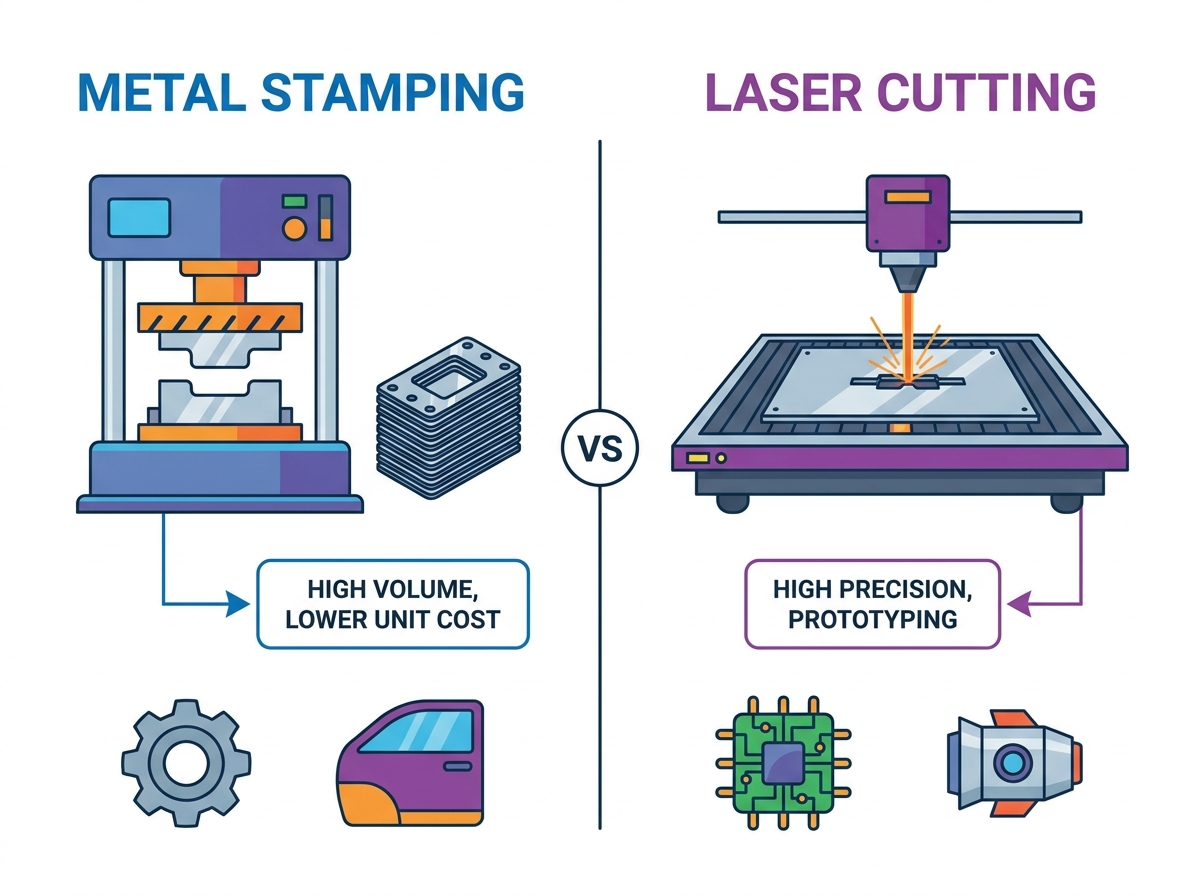
To navigate this challenge, manufacturers must evaluate Metal Stamping vs Laser Cutting as the two dominant methodologies for part production. Both processes transform flat sheet metal into functional components, but they operate on fundamentally different principles. Metal stamping relies on massive physical force and custom hard tooling. Laser cutting utilizes focused thermal energy guided by software. The optimal choice depends entirely on a strict evaluation of production volume, design stability, and specific material requirements.
Volume Dictates Methodology: Laser cutting provides up to a 40% cost reduction for low-to-medium volume runs (typically under 3,000 units) by eliminating the typical $15,000+ upfront tooling costs associated with stamping.
Design Agility vs. Fixed Production: Laser cutting allows for instantaneous, software-driven design iterations. Metal stamping requires expensive, time-consuming die modifications for any design change.
Precision and Edge Quality Realities: Both methods achieve high precision, but they produce different edge characteristics (mechanical shear vs. thermal cut/Heat-Affected Zone), impacting secondary finishing requirements.
The Piercing Bottleneck: Laser throughput is heavily influenced by material thickness, where piercing (hole drilling) can take up to 15 seconds per hole, whereas metal stamping punches holes instantaneously.
The Crossover Point: Every project has a mathematical break-even point where the amortized cost of a stamping die becomes cheaper than the continuous machine-time cost of laser cutting.
Table of Contents
Selecting the right fabrication process requires aligning production capabilities with the current lifecycle stage of the product. During prototyping and initial market rollout, designs frequently change. This volatility requires a manufacturing process with low Non-Recurring Engineering (NRE) costs. You need the ability to pivot without throwing away expensive tooling. Conversely, mass production demands the lowest possible unit cost, making higher NRE investments acceptable and necessary.
We see this constantly on the shop floor. A client brings a beta design and wants 500 units. Hard tooling makes zero sense here. We run it on the laser. Six months later, the design is locked, and they need 50,000 units annually. That is when we build the progressive die.
The geometry of the final part heavily influences the manufacturing decision. Laser cutting excels at producing intricate 2D flat blanks. If those laser-cut parts require 3D geometries, they must undergo secondary fabrication steps. You will need press brake bending, hardware insertion, or manual welding. Each secondary step adds labor, time, and potential for error.
Metal stamping operates differently. A progressive stamping press can execute blanking, piercing, and complex 3D forming in a single press stroke. The material feeds from a coil, moves through multiple stations in the die, and drops out as a finished 3D part. This eliminates secondary manual handling entirely.
Frozen designs are an absolute prerequisite for metal stamping. Once a die is machined from hardened tool steel, altering the design requires physically modifying the tooling. You have to pull the die from the press, send it to the tool room, wire EDM new inserts, and test it again. This process incurs severe delays and substantial costs.
Volatile designs necessitate laser cutting. Because lasers are driven entirely by CAD/CAM files, engineers can modify a hole diameter or alter a profile contour in the software. The operator loads the new file, and the machine cuts the new revision immediately without financial penalty.
The final application's tolerance requirements and acceptable edge conditions frame the initial manufacturing decision. Both processes achieve tight tolerances, but they leave distinct edge conditions. Mechanical shearing creates a rollover zone, a shear zone, and a rough break zone. Thermal cutting leaves striations and can produce dross on the bottom edge.
Understanding these realities dictates whether secondary operations like deburring, grinding, or machining will be required to meet the final specification. If you need a perfectly square edge for a flush welding joint, a laser cut edge might require secondary machining to remove the heat-affected zone.
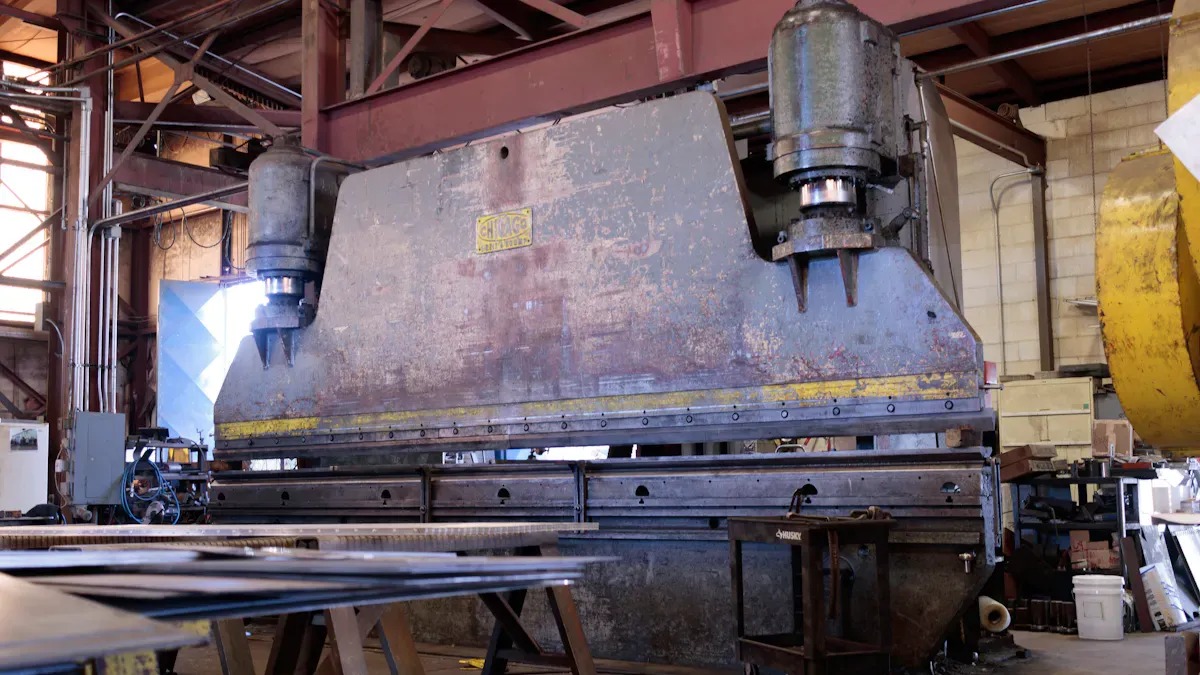
Metal stamping transforms flat sheet metal into specific shapes using immense mechanical or hydraulic pressure. The sheet metal feeds into a press containing a custom-machined die. As the press cycles, the upper die forces the material into the lower die, executing operations like blanking, piercing, and forming in a fraction of a second.
The reality of custom tooling creation defines the stamping process. Building a progressive die involves engineering, machining, assembling, and testing hardened steel components. Lead times often stretch from several weeks to a few months. The upfront capital required frequently exceeds $15,000, depending on the complexity and size of the part.
This initial investment creates a barrier to entry for low-volume projects. However, it unlocks unparalleled efficiency at scale. Once the die is built and dialed in, the press can run at 60 to 200 strokes per minute. The machine does the heavy lifting, and the labor cost per part drops to almost nothing.
Progressive die stamping differs significantly from simpler mechanical methods. Shearing utilizes straight blades to make simple, straight-line cuts, prioritizing speed for basic rectangular blanks. Turret punch pressing uses standard, modular tooling to punch standard hole patterns and simple perimeters.
Progressive stamping uses highly customized tooling to create complex, multi-feature 3D parts rapidly. The material moves through sequential stations within a single die block. Station one might pierce pilot holes. Station two blanks the outline. Station three forms a flange. Station four cuts the part free from the carrier web.
Metal stamping dominates industries where speed, consistency, and volume are paramount. Optimal use cases include:
Automotive body panels and structural brackets.
Consumer electronics internal chassis components.
High-volume fasteners, clips, and terminals.
Appliance housings and internal structural supports.
Electrical contacts and shielding components.
Laser cutting utilizes focused, high-powered laser beams to melt, burn, or vaporize sheet metal. Modern fabrication facilities primarily use Fiber lasers for thin to medium metals and CO2 lasers for thicker plates or non-metallic materials. The laser head moves across the material guided by precise CNC systems, executing complex geometries with minimal setup.
The primary advantage of laser cutting is the complete elimination of physical custom tooling. Production relies entirely on CAD/CAM files. Operators load the material, import the nesting program, and initiate the cut. This digital workflow allows for same-day production and zero-cost design iterations.
If an engineer realizes a mounting hole is off by two millimeters, they update the DXF file. The operator updates the nest, and the next part off the machine is correct. You cannot do that with a stamping die.
Before a laser can cut a profile, it must penetrate the material. This technical process is known as piercing. The laser pulses high energy into a single spot to drill an initial entry hole before executing the cutting path. Piercing times scale dramatically with material thickness.
On thick steel plates, a laser cutting machine can spend up to 15 seconds just drilling a single entry hole. On parts with a high density of internal holes, this piercing bottleneck severely impacts total throughput. A stamping press punches all those holes simultaneously in one stroke.
Laser cutting thrives in environments requiring flexibility and precision without volume commitments. Optimal use cases include:
Custom electrical enclosures and control panels.
Aerospace components requiring exotic alloys and tight tolerances.
Low-batch architectural panels and decorative screens.
Rapid prototyping for product development cycles.
Heavy equipment brackets produced in low annual quantities.
The financial evaluation centers on NRE costs versus per-part production costs. Laser cutting features a $0 tooling cost, contrasting sharply with the high initial cost of stamping dies. This dynamic yields up to a 40% cost savings for short runs under 3,000 units when using lasers.
Per-part production costs diverge at scale. Stamping yields a fraction-of-a-cent per-part cost because the press cycles multiple times per minute. Laser cutting maintains a relatively flat, higher per-part cost due to continuous machine time, electricity consumption, and expensive assist gas usage.
Amortization math dictates the decision. You must calculate how tooling costs are absorbed over the total production run. A $20,000 die amortized over 100,000 parts adds only $0.20 to the unit cost, quickly offsetting the slower cycle times of a laser.
Cost Factor | Metal Stamping | Laser Cutting |
|---|---|---|
Upfront Tooling (NRE) | High ($15,000+) | Zero ($0) |
Per-Part Cost at Scale | Extremely Low | Moderate to High |
Design Change Cost | High (Tooling Modification) | Zero (Software Update) |
Assist Gas Consumption | None | High (Nitrogen/Oxygen) |
Both methods offer exceptional dimensional accuracy. Precision stamping typically holds standard industry tolerances of ±0.005 inches. Modern fiber lasers can achieve tighter profile tolerances, often reaching ±0.002 inches on flat blanks. The critical difference lies in edge characteristics.
Stamping produces a mechanical shearing effect, resulting in a distinct rollover, a burnished shear zone, and a rougher fracture zone. Laser cutting leaves a thermal edge characterized by vertical striations and potential dross accumulation on the bottom face.
Laser cutting introduces a Heat-Affected Zone (HAZ). The intense thermal energy alters the metallurgical structure along the cut edge. This can cause localized hardening or micro-cracking in certain alloys, which frequently necessitates secondary machining if the edge requires subsequent tapping or precise bending.
Time-to-first-part heavily favors laser cutting. A laser can produce a physical part hours after receiving a CAD file. Stamping requires weeks or months to machine, assemble, try out, and test a progressive die.
Throughput at scale completely reverses this advantage. Laser cutting features a linear time-per-part metric. Cutting two parts takes exactly twice as long as cutting one. Stamping produces multiple complex features simultaneously in a single, fractional-second press stroke.
The laser piercing bottleneck further degrades thermal cutting speed. A laser cutting machine can spend up to 15 seconds drilling a single entry hole on thick plates. This causes a severe production lag on parts with high hole-density compared to the instantaneous mechanical punching action of a stamping press.
Both processes handle carbon steel, stainless steel, aluminum, and copper effectively. Historically, lasers struggled with highly reflective materials like copper and brass, though modern fiber lasers have largely mitigated this issue.
Thickness constraints dictate equipment selection. Stamping thick plate metal requires massive press tonnage and robust die construction to prevent tooling failure and material cracking. Lasers face wattage limits. As material thickness increases, laser beam divergence causes edge quality to deteriorate, resulting in wider kerfs and heavier dross.
Every sheet metal project has a mathematical break-even point. Calculating this volume requires a specific formula: (Stamping Tooling Cost) / (Laser Unit Cost - Stamping Unit Cost) = Break-Even Quantity. If your projected volume exceeds this quantity, stamping becomes the more economical choice.
Accurate calculations must factor in hidden downstream costs. Stamping requires die maintenance, sharpening, and storage. Laser cutting consumes expensive assist gases like nitrogen or oxygen and often requires secondary fabrication. A laser-cut part might need manual press brake bending, whereas a stamped part emerges fully formed from the die.
Many successful manufacturers employ hybrid approaches. They utilize laser cutting for initial market entry, prototypes, and beta phases. This allows for design tweaks based on field testing. Once the design is frozen and market demand guarantees high volume, they transition to progressive die stamping to maximize long-term profitability.
Stamping carries specific operational risks. Die wear causes tolerance drift over time, requiring maintenance downtime. The most catastrophic risk is the cost of design changes after the tooling is cut. Mitigation requires rigorous prototyping, utilizing virtual simulation software to predict material flow, and employing modular die designs where individual punch inserts can be swapped without rebuilding the entire tool.
Laser cutting presents different challenges. Thermal distortion frequently warps thin materials. Micro-cracking within the Heat-Affected Zone can compromise structural integrity. Throughput bottlenecks occur on thick materials with complex geometries and numerous pierce points. Mitigation involves optimizing laser parameters, utilizing high-pressure nitrogen assist gas to cool the cut zone, and executing strict capacity planning to manage machine time.
Request a dual-quote analysis from your fabrication partner to compare tooling amortization against flat laser rates.
Calculate your specific volume crossover point based on actual tooling and unit costs for your exact geometry.
Evaluate your internal design roadmap to ensure you do not commit to hard tooling before the product geometry is fully locked.
Audit your secondary operation requirements to see if in-die forming can eliminate manual press brake labor.
With years of experience in precision manufacturing, Emax has become a trusted OEM and custom manufacturing partner for customers across North America, Europe, and other global markets. The company specializes in precision CNC machining, sheet metal fabrication, welding fabrication, metal stamping, and complete custom manufacturing solutions, serving industries such as industrial equipment, automation, automotive, medical devices, electronics, and energy.
Supported by advanced CNC machining centers, experienced engineering teams, and a comprehensive quality management system, Emax is committed to delivering high-precision, cost-effective components with consistent quality, fast turnaround times, and dependable technical support throughout every stage of product development and mass production.
A: The transition typically occurs between 3,000 and 10,000 units. However, part complexity and the initial $15,000+ tooling threshold significantly alter this number. Highly complex parts might justify stamping sooner, while simple flat blanks might remain on lasers longer.
A: Yes, lasers often exceed stamping in 2D profile accuracy, reaching ±0.002 inches. However, stamping controls complex 3D forms, bends, and overall part-to-part repeatability much better over large production runs.
A: Thick materials require massive press tonnage for stamping, which increases tooling costs. For lasers, thick plates cause beam divergence, reducing edge quality, and impose a severe 15-second piercing time penalty per hole.
A: Yes. Laser cutting creates a Heat-Affected Zone (HAZ). The thermal energy alters the material's microstructure, often hardening the edge. This can cause micro-cracking and negatively affect secondary operations like tapping or bending.
A: Shearing executes simple straight cuts. Turret punching uses standard tools for basic geometries. Progressive stamping uses custom-machined tooling to perform multiple complex operations simultaneously to create highly complex 3D parts rapidly.
A: Yes, a hybrid lifecycle approach is very common. Manufacturers use laser cutting for prototyping and beta runs to save up to 40% upfront. Once the design is frozen and volume increases, they invest in stamping for mass production.